
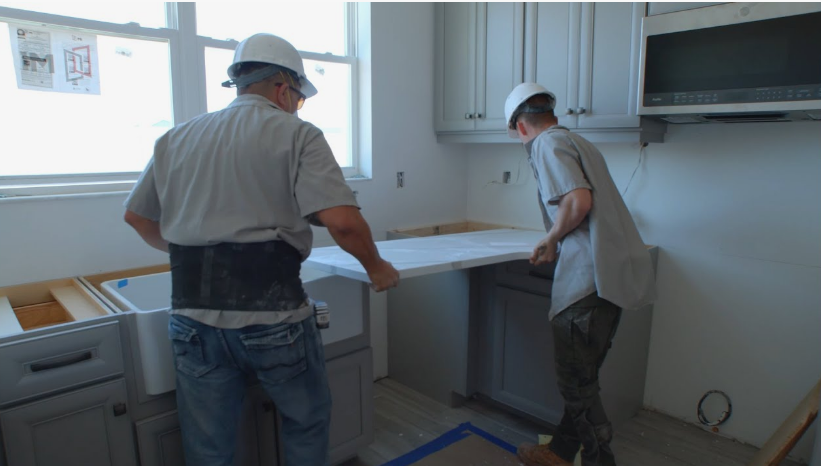
The Quartz Countertop Installation Process: Step by Step
Understanding what happens during a professional installation helps homeowners appreciate the complexity involved. Here’s how a qualified countertop installation contractor typically approaches a project:
1. Template Creation
Before any stone is cut, precise measurements are taken. A quartz countertop contractor creates a template—either digitally using laser technology or physically with materials like cardboard or wood strips. This template captures:
- Exact cabinet dimensions
- Wall irregularities (walls are rarely perfectly straight)
- Locations of plumbing, electrical outlets, and appliances
- Sink and cooktop cutout positions
Digital templating offers superior accuracy, often within 1/32 of an inch. Many professional countertop installation companies now use laser templating to eliminate guesswork.
2. Material Selection and Slab Inspection
Once measurements are finalized, slabs are selected. A trusted quartz countertop company will inspect each slab for:
- Color consistency
- Pattern alignment
- Visible defects or damage
- Vein matching for seamless appearance across multiple slabs
Because quartz is engineered, pattern variation is intentional and controlled. An experienced countertop contractor helps homeowners select slabs that achieve their desired aesthetic while ensuring structural integrity.
3. Fabrication
Fabrication is where raw slabs become finished countertops. This process occurs in a fabrication shop, not on-site. Using the digital template, computer-controlled saws cut slabs with precision. Edge profiles—from simple eased edges to intricate ogee or waterfall designs—are shaped and polished. Sink and cooktop cutouts are completed, and the surface is refined to a uniform finish.
Professional quartz countertop contractors invest in state-of-the-art fabrication equipment to ensure:
- Clean, chip-free cuts
- Consistent edge profiles
- Proper reinforcement for undermount sinks
- Accurate seam preparation
4. Site Preparation
Before installation day, the countertop installation company coordinates with homeowners to prepare the site:
- Existing countertops are removed and disposed of
- Cabinetry is checked for level and structural integrity
- Plumbing is temporarily capped
- Appliances are moved if necessary
Leveling cabinets is critical. Even a 1/8-inch variance can cause stress on quartz slabs, leading to cracks over time. A meticulous quartz countertop contractor addresses these details before the first slab is placed.
5. Installation
Installation day is when fabrication meets your home. The countertop installation contractor arrives with the finished slabs, carefully transported on specialized racks to prevent damage. The process includes:
- Dry fitting: Slabs are positioned to verify fit before permanent placement
- Seam creation: Seams are joined using color-matched epoxy and vacuum pressure to achieve near-invisible connections
- Leveling: Shims and adhesive ensure every surface is perfectly level
- Securing: Countertops are fastened to cabinetry with appropriate adhesives and mechanical fasteners
- Cutout finishing: Sink and cooktop openings are refined and sealed
A professional quartz countertop company works efficiently while maintaining cleanliness, using dust containment systems and protecting surrounding areas.
6. Final Detailing and Cleanup
After installation, the countertop contractor performs final touches:
- Excess adhesive is cleaned from seams
- Surfaces are polished to remove any residue
- Sinks and faucets are reconnected (often by a plumber coordinated through the company)
- Backsplashes are installed if part of the scope
- A final walkthrough ensures homeowner satisfaction
Common Quartz Countertop Installation Challenges
Even with professional countertop installation services, certain challenges can arise. A reputable countertop installation company anticipates and addresses these issues:
Seam Visibility
Quartz seams are necessary for larger layouts. While skilled contractors make seams nearly invisible, some variation in pattern or color may be detectable. A transparent quartz countertop contractor sets realistic expectations upfront.
Cabinet Alignment
Uneven cabinets are common in older homes. Professional installers use shims and leveling techniques to compensate, but significant structural issues may require cabinet adjustments before installation.
Overhang Support
Quartz countertops with overhangs beyond 10 to 12 inches require additional support. This may include corbels, brackets, or plywood substrate. A knowledgeable countertop installation company ensures proper support is specified during the templating phase.
Sink and Faucet Compatibility
Undermount sinks require precise cutouts and proper sealing. A quartz countertop contractor coordinates with plumbers to ensure compatibility and prevent water damage at the sink rim.
Quartz vs. Other Countertop Materials
When considering countertop installation, homeowners often compare quartz to alternatives. Here’s how quartz stacks up:
| Material | Pros | Cons |
|---|---|---|
| Quartz | Non-porous, no sealing, consistent appearance, durable | Higher upfront cost, heat sensitive, requires professional installation |
| Granite | Natural variation, heat resistant | Requires sealing, porous, can harbor bacteria if unsealed |
| Marble | Elegant appearance, cool surface | Soft, easily etched and stained, high maintenance |
| Laminate | Affordable, DIY-friendly | Less durable, seams visible, susceptible to heat and moisture |
| Solid Surface | Seamless appearance, repairable | Softer than quartz, less heat resistant |
A qualified countertop installation contractor can help homeowners weigh these options based on budget, lifestyle, and design preferences.
Maintaining Your Quartz Countertops After Installation
Once your quartz countertops are installed by a professional countertop installation company, proper maintenance ensures they remain beautiful for decades:
- Clean with mild soap and water: Avoid abrasive cleaners, bleach, or acidic products that can dull the finish.
- Use cutting boards: While quartz is scratch-resistant, knives can dull the surface and may leave marks.
- Use trivets and hot pads: Quartz withstands moderate heat, but extreme temperature changes can cause thermal shock. Never place hot pans directly from the oven or stovetop onto quartz.
- Wipe spills promptly: Although quartz is non-porous, prolonged exposure to certain liquids like wine or oil can stain the resin component.
- Avoid harsh chemicals: Products containing acetone, paint removers, or high-alkaline cleaners can damage the resin binder.
Your quartz countertop contractor should provide specific care instructions tailored to your chosen product.
Frequently Asked Questions (FAQs)
1. How much does quartz countertop installation cost?
Costs vary by location, slab selection, edge profiles, and project complexity. On average, quartz countertop installation ranges from $70 to $150 per square foot, including materials and professional installation. A countertop installation company typically provides detailed quotes after templating.
2. How long does quartz countertop installation take?
From template to final installation, expect 1 to 3 weeks. The templating and fabrication process requires precision. Installation itself typically takes one to two days, depending on project size and complexity.
3. Can quartz countertops be installed over existing countertops?
In some cases, quartz can be installed over existing laminate surfaces if the base is structurally sound and level. However, most quartz countertop contractors recommend removing existing countertops to ensure proper fit and support.
4. Do quartz countertops need to be sealed?
No. Quartz is non-porous and does not require sealing, unlike granite or marble. This is one of the key advantages highlighted by countertop installation companies.
5. Are quartz countertops heat resistant?
Quartz resists moderate heat but can be damaged by extreme or sudden temperature changes. A quartz countertop contractor will recommend using trivets or hot pads to protect the surface.
6. Can I install quartz countertops myself?
DIY quartz installation is not recommended. Quartz slabs are heavy, brittle, and require specialized tools for cutting and seaming. Professional countertop installation contractors have the equipment, expertise, and insurance to handle the job safely and correctly.
7. How do I choose the right quartz countertop installation company?
Look for:
- Experience: Years in business and portfolio of completed projects
- Certifications: Industry affiliations and manufacturer certifications
- Insurance: Liability and workers’ compensation coverage
- Reviews: Verified customer feedback on platforms like Google, Houzz, or the Better Business Bureau
- Warranty: Written warranty covering materials and workmanship
8. What edge profiles are available for quartz countertops?
Common edge profiles include:
- Eased (simple square with slightly rounded edge)
- Bevel (angled edge)
- Ogee (S-shaped, traditional profile)
- Bullnose (fully rounded)
- Waterfall (vertical drop continuing down cabinet sides)
A countertop installation company can show samples and recommend profiles that suit your design style.
9. Can quartz be used for bathroom vanities and backsplashes?
Absolutely. Quartz is an excellent choice for bathroom vanities due to its moisture resistance and low maintenance. Many homeowners also choose full-height quartz backsplashes for a seamless, easy-to-clean surface.
10. What if my quartz countertop gets damaged?
Minor chips or scratches can sometimes be repaired by a quartz countertop contractor using color-matched epoxy and professional polishing. For significant damage, slab replacement may be necessary. Many countertop installation companies offer repair services or warranties covering defects.
Final Thoughts
A quartz countertop is an investment in your home’s beauty, functionality, and value. But the material alone isn’t enough—the quality of installation determines how that investment performs over time.
Choosing a professional quartz countertop installation company or an experienced countertop installation contractor ensures that your countertops are fabricated precisely, installed safely, and supported by expertise that protects your investment. From the first template to the final polish, a skilled quartz countertop contractor transforms raw slabs into the centerpiece of your kitchen or bathroom.
If you’re considering quartz for your next renovation, don’t settle for less than professional installation. The difference between a good countertop and a great one lies in the hands of the team you choose.Understanding what happens during a professional installation helps homeowners appreciate the complexity involved. Here’s how a qualified countertop installation contractor typically approaches a project:
1. Template Creation
Before any stone is cut, precise measurements are taken. A quartz countertop contractor creates a template—either digitally using laser technology or physically with materials like cardboard or wood strips. This template captures:
- Exact cabinet dimensions
- Wall irregularities (walls are rarely perfectly straight)
- Locations of plumbing, electrical outlets, and appliances
- Sink and cooktop cutout positions
Digital templating offers superior accuracy, often within 1/32 of an inch. Many professional countertop installation companies now use laser templating to eliminate guesswork.
2. Material Selection and Slab Inspection
Once measurements are finalized, slabs are selected. A trusted quartz countertop company will inspect each slab for:
- Color consistency
- Pattern alignment
- Visible defects or damage
- Vein matching for seamless appearance across multiple slabs
Because quartz is engineered, pattern variation is intentional and controlled. An experienced countertop contractor helps homeowners select slabs that achieve their desired aesthetic while ensuring structural integrity.
3. Fabrication
Fabrication is where raw slabs become finished countertops. This process occurs in a fabrication shop, not on-site. Using the digital template, computer-controlled saws cut slabs with precision. Edge profiles—from simple eased edges to intricate ogee or waterfall designs—are shaped and polished. Sink and cooktop cutouts are completed, and the surface is refined to a uniform finish.
Professional quartz countertop contractors invest in state-of-the-art fabrication equipment to ensure:
- Clean, chip-free cuts
- Consistent edge profiles
- Proper reinforcement for undermount sinks
- Accurate seam preparation
4. Site Preparation
Before installation day, the countertop installation company coordinates with homeowners to prepare the site:
- Existing countertops are removed and disposed of
- Cabinetry is checked for level and structural integrity
- Plumbing is temporarily capped
- Appliances are moved if necessary
Leveling cabinets is critical. Even a 1/8-inch variance can cause stress on quartz slabs, leading to cracks over time. A meticulous quartz countertop contractor addresses these details before the first slab is placed.
5. Installation
Installation day is when fabrication meets your home. The countertop installation contractor arrives with the finished slabs, carefully transported on specialized racks to prevent damage. The process includes:
- Dry fitting: Slabs are positioned to verify fit before permanent placement
- Seam creation: Seams are joined using color-matched epoxy and vacuum pressure to achieve near-invisible connections
- Leveling: Shims and adhesive ensure every surface is perfectly level
- Securing: Countertops are fastened to cabinetry with appropriate adhesives and mechanical fasteners
- Cutout finishing: Sink and cooktop openings are refined and sealed
A professional quartz countertop company works efficiently while maintaining cleanliness, using dust containment systems and protecting surrounding areas.
6. Final Detailing and Cleanup
After installation, the countertop contractor performs final touches:
- Excess adhesive is cleaned from seams
- Surfaces are polished to remove any residue
- Sinks and faucets are reconnected (often by a plumber coordinated through the company)
- Backsplashes are installed if part of the scope
- A final walkthrough ensures homeowner satisfaction
Common Quartz Countertop Installation Challenges
Even with professional installation, certain challenges can arise. A reputable countertop installation company anticipates and addresses these issues:
Seam Visibility
Quartz seams are necessary for larger layouts. While skilled contractors make seams nearly invisible, some variation in pattern or color may be detectable. A transparent quartz countertop contractor sets realistic expectations upfront.
Cabinet Alignment
Uneven cabinets are common in older homes. Professional installers use shims and leveling techniques to compensate, but significant structural issues may require cabinet adjustments before installation.
Overhang Support
Quartz countertops with overhangs beyond 10 to 12 inches require additional support. This may include corbels, brackets, or plywood substrate. A knowledgeable countertop installation company ensures proper support is specified during the templating phase.
Sink and Faucet Compatibility
Undermount sinks require precise cutouts and proper sealing. A quartz countertop contractor coordinates with plumbers to ensure compatibility and prevent water damage at the sink rim.
Quartz vs. Other Countertop Materials
When considering countertop installation, homeowners often compare quartz to alternatives. Here’s how quartz stacks up:
| Material | Pros | Cons |
|---|---|---|
| Quartz | Non-porous, no sealing, consistent appearance, durable | Higher upfront cost, heat sensitive, requires professional installation |
| Granite | Natural variation, heat resistant | Requires sealing, porous, can harbor bacteria if unsealed |
| Marble | Elegant appearance, cool surface | Soft, easily etched and stained, high maintenance |
| Laminate | Affordable, DIY-friendly | Less durable, seams visible, susceptible to heat and moisture |
| Solid Surface | Seamless appearance, repairable | Softer than quartz, less heat resistant |
A qualified countertop installation contractor can help homeowners weigh these options based on budget, lifestyle, and design preferences.
Maintaining Your Quartz Countertops After Installation
Once your quartz countertops are installed by a professional countertop installation company, proper maintenance ensures they remain beautiful for decades:
- Clean with mild soap and water: Avoid abrasive cleaners, bleach, or acidic products that can dull the finish.
- Use cutting boards: While quartz is scratch-resistant, knives can dull the surface and may leave marks.
- Use trivets and hot pads: Quartz withstands moderate heat, but extreme temperature changes can cause thermal shock. Never place hot pans directly from the oven or stovetop onto quartz.
- Wipe spills promptly: Although quartz is non-porous, prolonged exposure to certain liquids like wine or oil can stain the resin component.
- Avoid harsh chemicals: Products containing acetone, paint removers, or high-alkaline cleaners can damage the resin binder.
Your quartz countertop contractor should provide specific care instructions tailored to your chosen product.
Frequently Asked Questions (FAQs)
1. How much does quartz countertop installation cost?
Costs vary by location, slab selection, edge profiles, and project complexity. On average, quartz countertop installation ranges from $70 to $150 per square foot, including materials and professional installation. A countertop installation company typically provides detailed quotes after templating.
2. How long does quartz countertop installation take?
From template to final installation, expect 1 to 3 weeks. The templating and fabrication process requires precision. Installation itself typically takes one to two days, depending on project size and complexity.
3. Can quartz countertops be installed over existing countertops?
In some cases, quartz can be installed over existing laminate surfaces if the base is structurally sound and level. However, most quartz countertop contractors recommend removing existing countertops to ensure proper fit and support.
4. Do quartz countertops need to be sealed?
No. Quartz is non-porous and does not require sealing, unlike granite or marble. This is one of the key advantages highlighted by countertop installation companies.
5. Are quartz countertops heat resistant?
Quartz resists moderate heat but can be damaged by extreme or sudden temperature changes. A quartz countertop contractor will recommend using trivets or hot pads to protect the surface.
6. Can I install quartz countertops myself?
DIY quartz installation is not recommended. Quartz slabs are heavy, brittle, and require specialized tools for cutting and seaming. Professional countertop installation contractors have the equipment, expertise, and insurance to handle the job safely and correctly.
7. How do I choose the right quartz countertop installation company?
Look for:
- Experience: Years in business and portfolio of completed projects
- Certifications: Industry affiliations and manufacturer certifications
- Insurance: Liability and workers’ compensation coverage
- Reviews: Verified customer feedback on platforms like Google, Houzz, or the Better Business Bureau
- Warranty: Written warranty covering materials and workmanship
8. What edge profiles are available for quartz countertops?
Common edge profiles include:
- Eased (simple square with slightly rounded edge)
- Bevel (angled edge)
- Ogee (S-shaped, traditional profile)
- Bullnose (fully rounded)
- Waterfall (vertical drop continuing down cabinet sides)
A countertop installation company can show samples and recommend profiles that suit your design style.
9. Can quartz be used for bathroom vanities and backsplashes?
Absolutely. Quartz is an excellent choice for bathroom vanities due to its moisture resistance and low maintenance. Many homeowners also choose full-height quartz backsplashes for a seamless, easy-to-clean surface.
10. What if my quartz countertop gets damaged?
Minor chips or scratches can sometimes be repaired by a quartz countertop contractor using color-matched epoxy and professional polishing. For significant damage, slab replacement may be necessary. Many countertop installation companies offer repair services or warranties covering defects.
Final Thoughts
A quartz countertop is an investment in your home’s beauty, functionality, and value. But the material alone isn’t enough—the quality of installation determines how that investment performs over time.
Choosing a professional quartz countertop installation company or an experienced countertop installation contractor ensures that your countertops are fabricated precisely, installed safely, and supported by expertise that protects your investment. From the first template to the final polish, a skilled quartz countertop contractor transforms raw slabs into the centerpiece of your kitchen or bathroom.
If you’re considering quartz for your next renovation, don’t settle for less than professional installation. The difference between a good countertop and a great one lies in the hands of the team you choose.